Playbook Development
Incident response playbooks built on your tools and your teams, then validated with your responders before a real incident.
What is Playbook Development?
Playbook Development delivers incident response playbooks built for your environment, for the scenarios you prioritize: compromised accounts, botnets, data exfiltration, phishing, privilege escalation, ransomware and web attacks.
Each playbook fits your technical context. It is built on the security tools deployed in your environment and shows, step by step, how to use them.
Each playbook also fits your organization. Every action is assigned to a role identified in your teams.
Today, with AI, anyone can produce a set of playbooks in a few hours. Writing the document is no longer the hard part. The hard part is making it match your tools and your organization, and making sure it can actually be executed.
Each playbook is then validated through an execution simulation run with your teams, in a guided mode. On a simple scenario, your responders walk through the playbook step by step. The gaps found are fixed and the playbook is updated.
The Strategic Question
"If an incident happened tomorrow, could our teams apply our playbooks with our tools?"
A playbook that has never been executed is still an assumption. Playbook Development delivers playbooks built on your environment, then validated with your own teams.
Why Playbook Development Matters
- Technical Fit: Every step relies on your security tools and shows how to use them
- Clear Responsibilities: Who detects, who decides, who executes, who communicates, based on your organization
- Execution Validated: Each playbook is walked through by your teams before a real incident
- Guided Simulation: Our consultants lead the simulation and answer your responders' questions
- Updated After Simulation: The gaps found during the simulation are fixed in the delivered playbook
- Compliance: Documented and tested response procedures (ISO 27001, NIST, PCI DSS)
Playbooks We Develop
You choose the scenarios that matter most to your organization
Compromised Accounts
Contain a stolen or abused account and find what the attacker did with it.
Botnets
Find infected hosts, cut their command-and-control traffic and clean them.
Data Exfiltration
Stop the data leak, scope what was taken and preserve the evidence.
Phishing
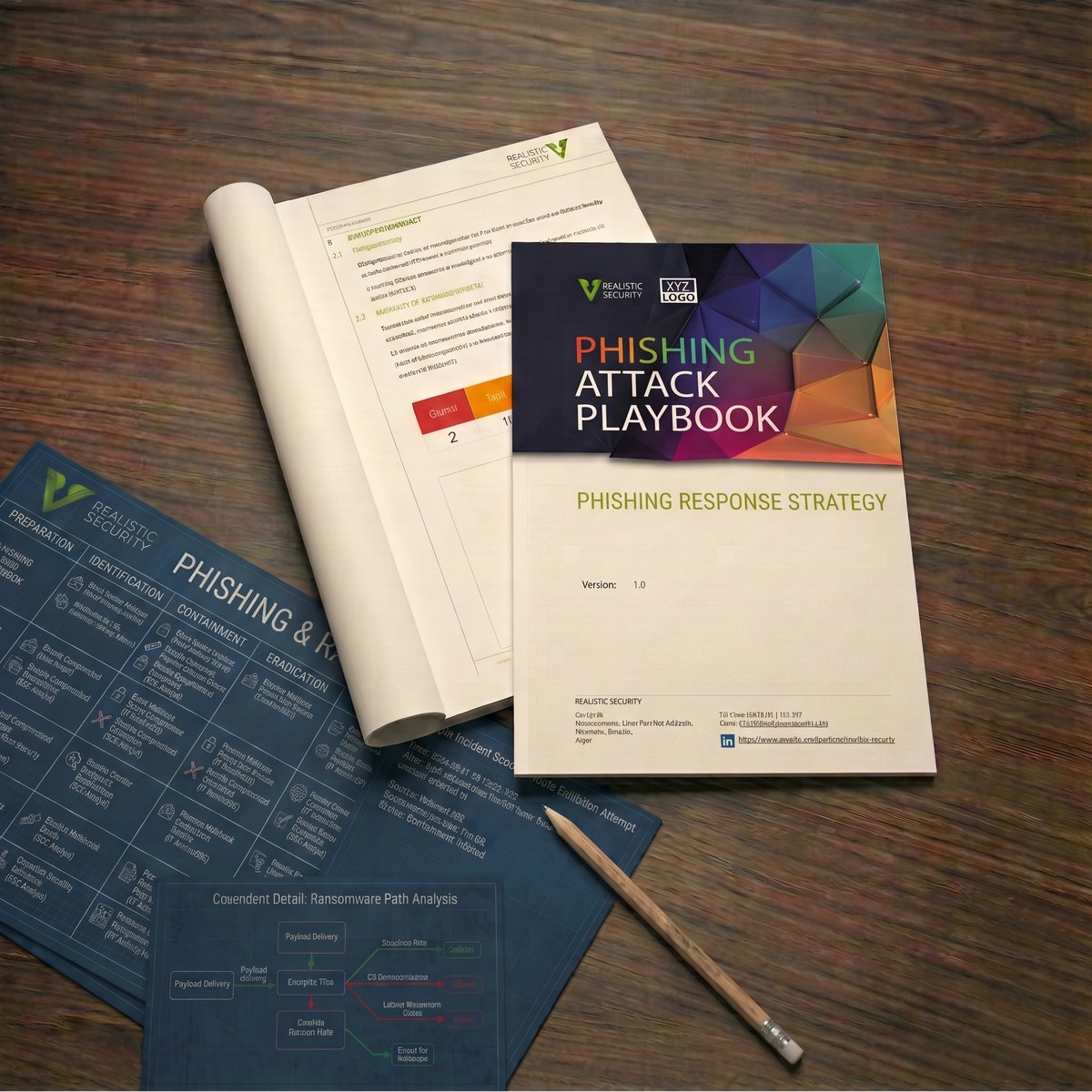
Handle a reported phishing email, from first analysis to clean-up of every mailbox.
Privilege Escalation
Respond when an attacker gains admin rights on a host or in the domain.
Ransomware
Isolate, contain and recover when files are encrypted and a ransom note appears.
Web Attacks
Respond to an attack on your websites, portals and APIs.
How We Build Your Playbooks
From your tools and your teams to a playbook you have already executed
Select Your Scenarios
We agree on the scenarios you want to cover first, based on your threats and priorities.
Map Your Tools
We study the security tools deployed in your environment and how your teams use them today.
Map Your Roles
We identify who detects, who decides, who executes and who communicates in your organization.
Write the Playbooks
We write each playbook step by step, using your tools and assigning every action to a role.
Guided Execution Simulation
On a simple scenario, your responders walk through the playbook step by step, guided by our consultants.
Fix & Deliver
The gaps found during the simulation are fixed, and you receive the updated, validated playbooks.
Your Incident Response Playbooks
You receive one playbook per scenario. Each one is built on your tools and your teams, and updated after the execution simulation.
Step-by-Step Response
Clear steps for each phase of the incident, from detection to recovery, showing how to use your own security tools.
Roles for Every Action
Every action is assigned to a role in your teams: who detects, who decides, who executes and who communicates.
Validated by Simulation
The gaps found while your responders walked through the playbook are fixed in the delivered version.
Ready to Build Playbooks That Work?
Get in touch with our incident response team to choose your scenarios and build playbooks your teams can really execute.