Digital Forensics Training
Acquire the evidence, then prove what happened on a Windows host: what ran, who logged in, and where the files came from.
- 4 days
- 6 to 8 participants
- Labs + final case
- Private, on-site or online
About the Course
An alert tells you something happened. Forensics tells you what, when and how. Your team learns to acquire evidence the right way. Then they read the Windows artifacts that answer the investigator's questions:
- Did it run? Prefetch, SRUM, Shimcache, Amcache.
- Where did it come from? Zone.Identifier, browser history.
- Who logged in, and what did they see? RDP logs, UAL, RDP bitmap cache.
The course ends with memory analysis in Volatility and live response at scale with Velociraptor.
Who it is for
- SOC analysts
- Incident responders
- Anyone moving into forensics
You should already know Windows basics (file system, registry, processes, event logs) and the incident response lifecycle
New to incident response? Take the Incident Response Training first.
You Will Be Able To
- Acquire disk and memory evidence, and choose live or dead-box analysis
- Prove a program ran, using Prefetch, SRUM, Shimcache and Amcache
- Rebuild user activity from UserAssist, Shellbags, UAL and browser history
- Reconstruct an RDP session from logs and the bitmap cache
- Trace file creation, deletion and download source in the MFT, $J and ADS
- Analyze a memory image with Volatility: processes, network, registry
- Hunt across many endpoints with Velociraptor and VQL
A night-time RDP login
An admin account logs in over RDP at night. A tool is downloaded, run and deleted. Your team gets a disk image and a memory dump.
Zone.Identifier shows where the file came from. Prefetch and Amcache prove it ran. The bitmap cache shows what the attacker saw. Memory shows the network connection. Then Velociraptor checks if other hosts look the same.
The team writes its findings as a timeline and presents them in a debrief.
Course Syllabus
9 modules
- Introduction & acquisition
Types of digital forensics, the investigation process, live vs dead-box forensics, evidence acquisition process and best practices.
- Evidence of execution
Prefetch and System Resource Usage Monitoring (SRUM).
- Browser forensics
Identify deleted history entries, recover history from the cache, and analyze search patterns and user behavior.
- RDP forensics
RDP log analysis and RDP bitmap cache rebuild.
- User activity
User Access Logging (UAL), UserAssist and Shellbags artifacts.
- NTFS file system
Alternate data streams, Zone.Identifier (source of downloads), MFT, UsnJrnl ($J) and $LogFile.
- Evidence of existence
Shimcache and Amcache, how they differ, and best practices.
- Memory forensics
Volatility: profiles and debugging symbols, processes, dumps, network, registry, MFT and Shimcache from memory.
- Live forensics
Velociraptor: deployment, clients, VQL, interactive file and registry analysis, hunting and artifacts.
Want this syllabus adapted for your team?
Request a proposalWhat Participants Take Home
- Course slides
- Lab guides for every module
- The queries and notes written during the labs
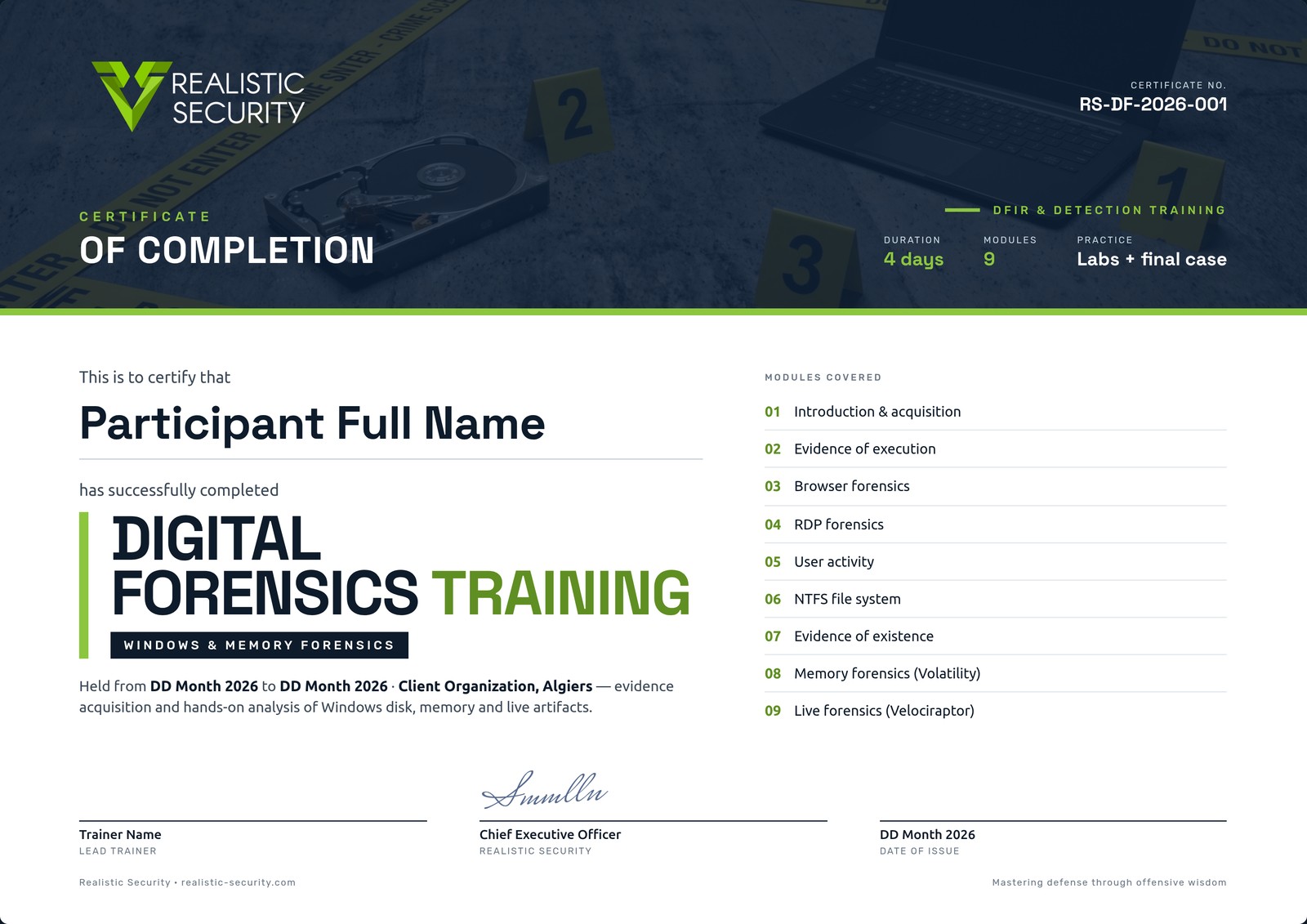
- A certificate of completion for each participant
Certificate of Completion
Each participant who completes the forensics labs and the final case receives a named, numbered certificate that lists the modules covered, signed by the lead trainer and our CEO.
Before the Course
What each participant needs on day one.
- RAM
- 8 GB min, 12 GB recommended
- Disk
- 50 GB free
- Network
- Internet access
Other Courses
Incident Response Training Attack & Detect
Run each attack yourself, then detect it, investigate it and respond, from the first alert to lessons learned.
View courseEDR & Threat Hunting Training
Deploy an EDR platform, then use it to hunt attacker behavior across your endpoints.
View courseDetection Engineering Training with Elastic Security
Start from attacker behavior and finish with tested detection rules on Elastic.
View coursePenetration Testing Training
From scoping to domain admin to the client report, mostly in the lab.
View courseTrain Your Team in Digital Forensics
Tell us your team size, your tools and your dates. We reply with a proposal adapted to your team.