Detection Engineering on Elastic
Start from attacker behavior and finish with tested detection rules on Elastic.
- 2 days
- 6 to 8 participants
- Step-by-step lab
- Private, on-site or online
About the Course
The attacks are already in the lab data. The SIEM did not alert. By the end of day 2, it does.
- Day 1: the method. Risk-informed priorities, MITRE ATT&CK, the rule lifecycle and an 8-step, test-driven process.
- Day 2: Elastic. ECS, KQL, EQL, ES|QL and every rule type, practised on attack data from a live Active Directory environment.
Who it is for
- SOC analysts
- Detection engineers
- Threat hunters
- Blue team members
- Security engineers
- CSIRT / incident responders
You should already know SIEM concepts, networking, Windows and Active Directory. No Elastic experience needed.
Good after the Incident Response or EDR & Threat Hunting Training.
You Will Be Able To
- Pick which techniques to detect first, based on your threats and assets
- Map a detection to ATT&CK techniques and data sources in the Navigator
- Write an EQL sequence rule and an ES|QL rule with enrichment
- Apply rule best practices: behaviors over IOCs, metadata, Sigma
- Follow an 8-step, test-driven rule development process
- Find your way in Elastic data: indices, data streams, ECS
- Tune a rule to cut false positives without opening a bypass
- Turn real attack telemetry into working detections
One lab, built step by step
The lab is not one final case. It is a set of detection exercises, grouped by attack technique. Each exercise checks one part of the course.
- Day 1: answer MITRE ATT&CK questions, map techniques to data sources, and choose which detections come first.
- Day 2: write each rule type on Elastic: custom query, threshold, new terms, indicator match, EQL sequence and ES|QL.
The attack data is already in the cluster, from a live Active Directory environment: a webshell, certutil downloading Mimikatz, a mass network scan, new AD authentications and encoded PowerShell. Your team tests each rule against this data, tunes the false positives and reviews the rules in the debrief.
Course Syllabus
5 modules · 2 parts
Part 1 Day 1: Detection foundations & engineering 3 modules
- Detection fundamentals
What detection is, and why it matters.
- Definition, goals and place in defense-in-depth
- Detection as a SOC function: "garbage in, garbage out"
- Case studies: NotPetya and SolarWinds
- Risk-informed detection with MITRE ATT&CK
Decide what to detect first, and why.
- Current threats, threat modeling, asset priorities and self-assessment
- ATT&CK for detection: tactics, techniques, groups, software, data sources
- ATT&CK Navigator and structured ATT&CK data
- Detection engineering process
How a good rule is built, tested and kept alive.
- Rule lifecycle and its triggers
- Best practices: behaviors over IOCs, metadata, Sigma
- False positives vs false negatives, and common bypass patterns
- The 8-step, test-driven rule development process
Part 2 Day 2: Detection rules on Elastic 2 modules
- Elastic data and queries
Find and read the data your rules run on.
- Indices, data streams, index patterns and data views
- Elastic Common Schema (ECS) and integrations
- Discover and Dev Tools
- KQL and Lucene
- Detection rules on Elastic
Write, test and tune every rule type.
- Custom query, threshold and new terms rules
- Indicator match and machine learning rules
- EQL in depth: sequences, maxspan, by / until / runs
- ES|QL in depth: ENRICH, LOOKUP JOIN, GROK, DISSECT, STATS
- Rule review and false-positive tuning
Lab exercises run through every module. Each one checks the part of the course you just finished.
Want this syllabus adapted for your team?
Request a proposalWhat Participants Take Home
- The complete slide deck
- The workshop materials and lab guide
- The detection rules written during the lab
- A certificate of completion for each participant
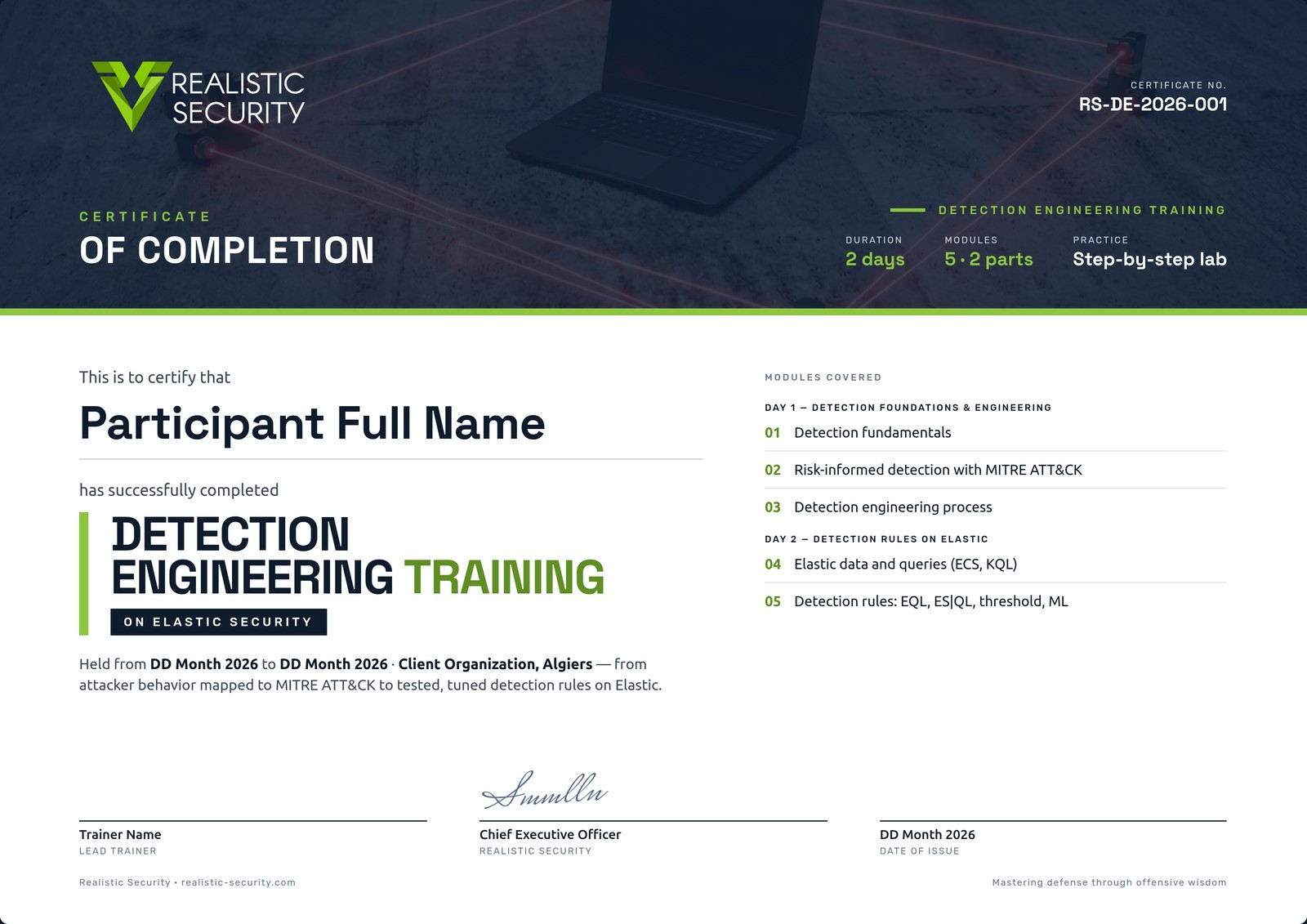
Certificate of Completion
Each participant who completes the step-by-step lab receives a named, numbered certificate that lists the modules covered, signed by the lead trainer and our CEO.
Before the Course
What each participant needs on day one.
- Laptop
- Any laptop. All labs run in the browser (Kibana), with no local installation.
- Network
- Internet access during the whole workshop
- Lab
- Provided: an Elastic cluster with pre-loaded attack telemetry
Other Courses
Incident Response Training Attack & Detect
Run each attack yourself, then detect it, investigate it and respond, from the first alert to lessons learned.
View courseDigital Forensics Training
Acquire the evidence, then prove what happened on a Windows host: what ran, who logged in, and where the files came from.
View courseEDR & Threat Hunting Training
Deploy an EDR platform, then use it to hunt attacker behavior across your endpoints.
View coursePenetration Testing Training
From scoping to domain admin to the client report, mostly in the lab.
View courseTrain Your Team in Detection Engineering
Tell us your team size, your tools and your dates. We reply with a proposal adapted to your team.